As the next part of the process of applying the fiberglass cloth to the hull turned into a bit of an epic saga, I felt it was necessary to split the story into two parts.
Once I had the joints and seams taped it was time to add the heavy sheathing that would seal, protect, and complete the construction of the hull portion of the boat. My hull is made of 9mm Meranti (Philippine Mahogany) plywood which the plans specify a cloth weight of 450 g/m2 or about 14 oz. I ordered the fiberglass kit from B&B along with my boat and they shipped me 30 yds of 1708 biaxial fabric for the hull.
1708 biaxial cloth is a dual layer system that features one layer of 17oz (about 600 g/m2) fiberglass with the warp and weft fibers woven at a 45 degree angle, as opposed to a traditional 90 degree orientation. This requires that the strands be stitched together to hold their shape as the weave does not inherently lock itself together. This layer is then combined with, and stitched to, a layer of 8oz (about 300 g/m2) chopped strand mat. This mat layer helps to promote adhesion and also helps the fabric hold more complex shapes. The CSM used in 1708 biaxial is especially formulated to be used with epoxy resin as most CSM is more commonly used with poly or vinyl ester resin layups.
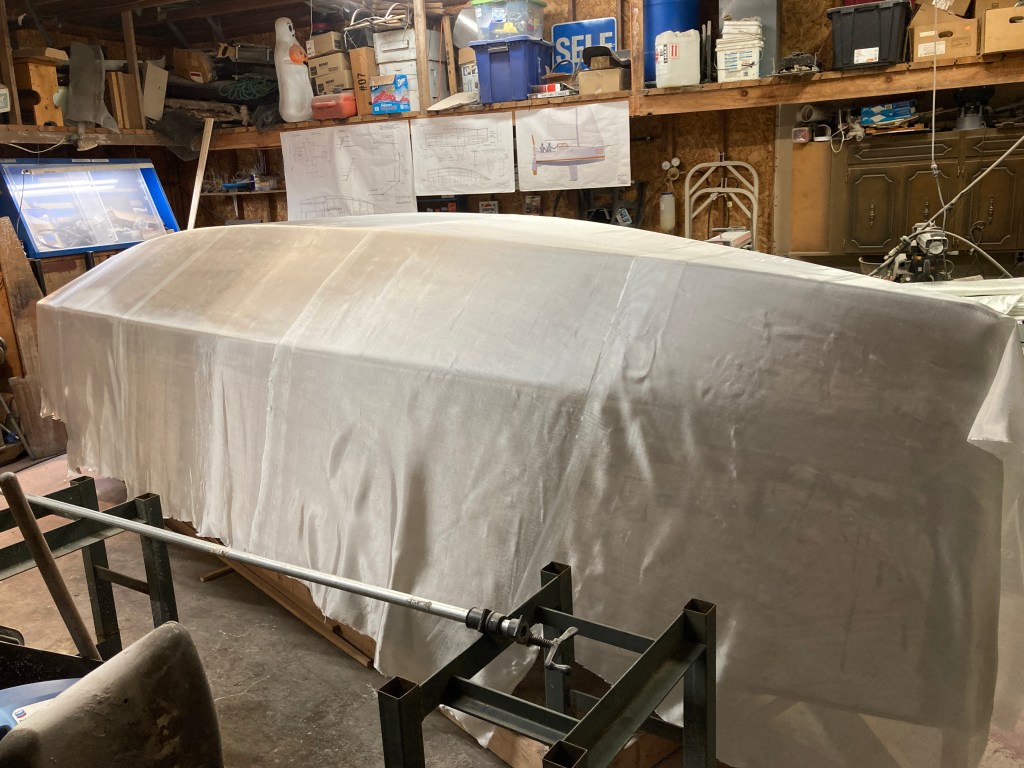

One layer of fiberglass, although it exceeded the strength requirements, seemed to be a bit light, so I decided to cover the 1708 in a layer of 6oz (200 g/m2) standard 90 degree boat cloth. This would not only help protect the stronger fabric during sanding but it would add strength by having glass fibers oriented in six directions.
I began by positioning the pieces of cloth on the dry hull and cutting them to length. I then rolled them up and stacked them in the order that they would go on the hull. I then began the fiberglassing process in the same way I have done it many times before although never using 1708.
I pre-coated the hull with epoxy in the area I would be working and gave the resin time to get tacky. I then added more resin to the substrate before laying on the cloth and proceeding to wet it out with more resin from the top down. Unfortunately the 1708 fabric was too thick to wet out from the top and the resin that I had applied to the hull was insufficient to wet out the layer of CSM stitched to the biaxial. This resulted in a dry layup where the bottom layer did not wet out or attach to the wood.

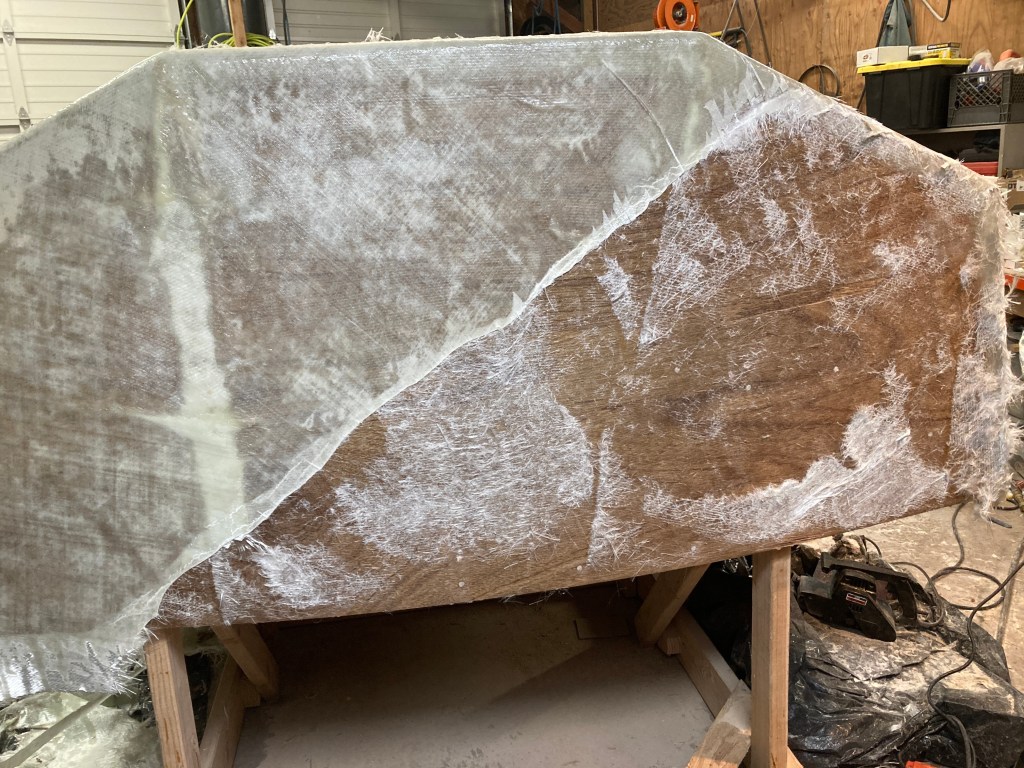
I managed to get three pieces of cloth on to the boat before I realized it was a serious problem and as the third piece had not yet hardened I was able to peel it off off the hull and discard it. The rest of the poorly bonded glass would have to be removed before I could proceed. I spent eight weekends using a putty knife and heat gun to peel off as much as I could, then I switched to the belt sander to grind off the rest. It was miserable, disheartening work.

With the hull finally all cleaned off and smooth, it was time to try to apply the cloth again. This time I set up a long table covered in plastic that I would use to pre wet the CSM side of the fabric before laying onto the hull. This worked perfectly. My helper and I would lay out the piece of cloth, wet out the CSM with resin, fold up the piece for handling, carry to the boat, and carefully unfold it into place. Then we would wet out the biaxial fabric from the top with additional resin, squeegee out the excess, and finally roll out the bubbles with the fin roller. Whew what a job!

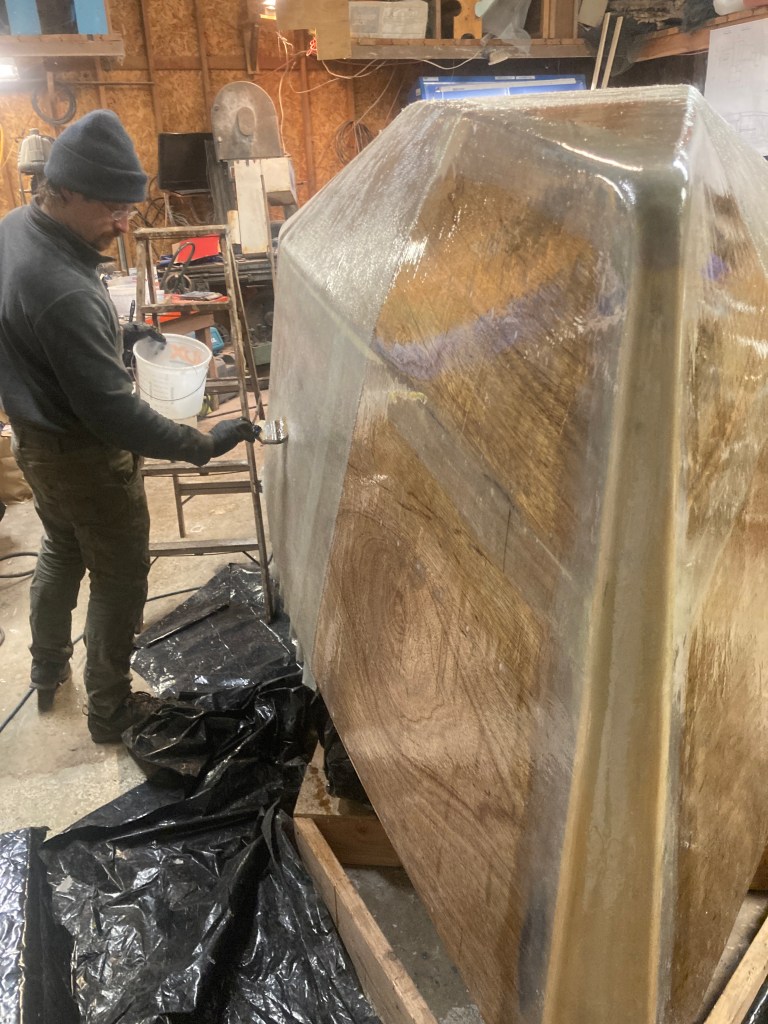

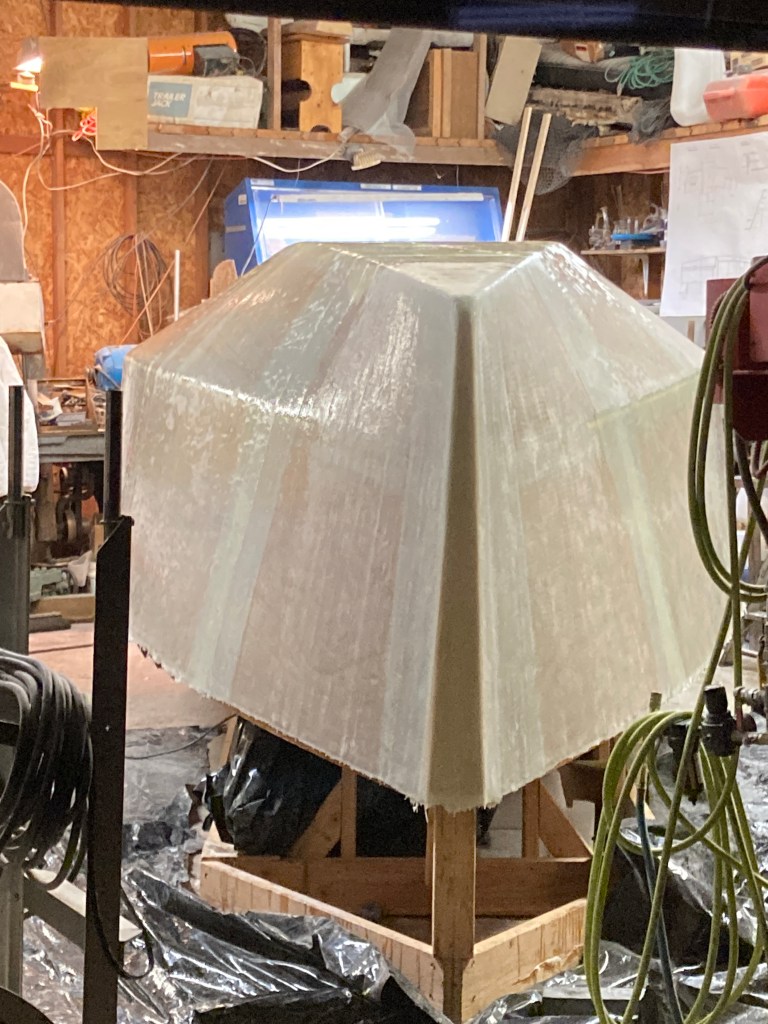
We used this process for the rest of the 1708 layer and everything went smoothly. The glass laid down nicely and we carefully removed all of the excess resin and bubbles. With this layer done I washed the blush off of the cured surface and scuffed the glass with a maroon scothbrite pad to prepare a mechanical bond for the next layer. I also used the DA sander to smooth down the areas where the glass overlapped to help the next layer lie down easily. With some help the 6oz cloth went on perfectly by simply pre-wetting the hull with resin and laying up the cloth like normal. With that the hull was finally sealed up completely and ready for fairing!


The combination of the 1708 (17oz cloth and 8oz CSM) and the 6oz cloth gave me a total glass weight of 31oz or 1050 g/m2. That is more than double the 450 g/m2 requirement for my plywood so hopefully it is good and strong! In addition, the combination of 45 degree biaxial and 90 degree cloth gives strength in all directions! Thank you for reading!

 Josh Kali - Ocean Racing